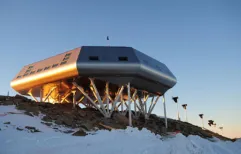
The C-shaped wooden side beams have now all been mounted. Next step involves tackling the exterior metal panels, as soon as the weather permits to do so.
BELARE 2007-2008: The Team Earns a Sleep In for Fast Progress
The building team spent just 5 days building the station's floor. That's roughly 500 m² of pine wood resting upon the metal struts. This rigid progress puts the building team a few days ahead of schedule! Progress has been such that the building team earned a day's rest over the week-end.
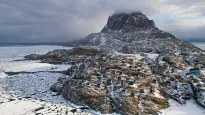
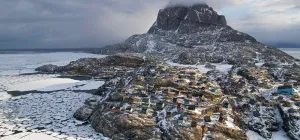
It is snowing lightly, the sky is overcast, but the sun still pierces through the clouds. A fresh breeze rises now and then upon the Utsteinen ridge, cooling any extremity that has not been covered. It is -12°C, but who knows what the wind chill is.
Building on site continues, no matter what the weather is like. When one activity slows down, another one picks up speed. There are always more than 20 people working up on the ridge and round abouts, and 6 who are out on a traverse between Utsteinen and Crown Bay. More than half the containers are now in Utsteinen.
Since the metal struts have been mounted on the Utsteinen ridge, work on the station has been advancing fast. Neither the weather nor the hard physical work has slowed the workmen down.
The Station's metal struts have emerged from the Utsteinen rock in just 3 days. With only two struts left to place, the early stages of the station's pre-construction in Brussels are now fully recognizable.
Seven people have left on another traverse. The rest of the team is either working on the ridge, filming those working on the ridge, building new bathroom facilities or cooking away to feed the team.
The time has come to focus on preparing the Princess Elisabeth for winter mode to make sure the station is able to run autonomously until the team returns in November. Departure is scheduled for Thursdday, February 12th.
With the scientists and several crew members having returned home, the attention of the remaining thirteen team members at the station turns to the many tasks they must complete before the end of the season. The next couple of weeks will be packed!
After one month in Antarctica collecting samples and data at the Princess Elisabeth and in the field, the scientists who came to the station this season will be departing on the next flight along with several members of the crew.
Scientific Field Expeditions Begin as the BELARE Team Welcomes 2026
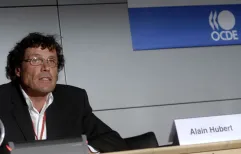
Last week as the BELARE team rang in 2026, the PASPARTOUT project began its field campaign for this season, the ROMA and SnowFlux projects continued setting up instruments in the vicinity of the Princess Elisabeth Antarctica. Soon Alain Hubert and Tim Grosrenaud will start their reconnaissance missions at the coast accompanied by Simon Steffen heading back out to work on instruments for the PEACE and NISAR projects.
New Team Members and Scientists Arrive in Time for Christmas
On December 19th, new crew members and scientists arrived at PEA to start their mission in Antarctica. Since their arrival, they’ve been doing mandatory safety training and preparing for their field missions.
Perseus Ready for Arrival: Runway Preparations, New Infrastructure, and Ongoing Science
As the Perseus International Airfield opens for incoming team mebers and scientists, operations at Princess Elisabeth Antarctica move full steam ahead for logistics, infrastructure, and science.
Newly Published Research from Baillet Latour Antarctica Fellow Sheds Light on Natural Carbon Capture in East Antarctica
The International Polar Foundation is delighted to share an exciting update from 2018 Baillet Latour Antarctica Fellow Dr. Kate Winter of Northumbria University, whose fieldwork around the Princess Elisabeth Antarctica contributed to a major peer-reviewed publication on carbon capture in East Antarctica.