


Moving Forward with Scientific Fieldwork
The scientific season is in full swing at Princess Elisabeth Antarctica (PEA).
The scientific season is in full swing at Princess Elisabeth Antarctica (PEA).
The weather has been very calm, and perhaps a bit too calm: lots of sunshine, almost no wind, and relatively mild temperatures. While these conditions make many outdoor tasks easier and safer, they can also be challenging for researchers who depend on specific weather patterns for their measurements.
Scientific Activities and Research Highlights
Michel Van Roozendael from the BELSPO-funded ROMA project has been busy lately installing the new instrument on the roof of Princess Elisabeth station. The Pandora system consists of an external measurement unit installed on the station's roof, and an internal computer system housed indoors to protect it from the cold. Michel has been busy connecting the roof-mounted measurement unit (similar in appearance to a CIMEL system) to the Pandora computer inside the station. Once the installation was complete, the next crucial step was calibration. Because these instruments need to point precisely at the sun, the settings depend strongly on their exact location and the local climatic conditions. After several test runs, the first results are very promising.
The goal is for the Pandora system to run autonomously throughout the Antarctic winter and to continuously collect data and monitor the status of the ozone layer over the Antarctic where a seasonal phenomenon reduces its thickness during the spring time - commonly known as the ‘ozone hole’. This phenomenon was dangerously amplified by the extensive use of CFC gases (formerly found in home appliances, i.e. refrigerators, air conditioners and humidifiers) used in our aerosols during the 1970’s and the 80’s until the Montreal protocol led to a worldwide ban (complete phase-out) to restore the thickness of this protective ozone layer against harmful solar UV radiation. For now, the Pandora, and the Brewer spectrophotometer will operate in parallel all winter long, allowing the team to compare and validate the measurements. Next season a third instrument, the BTS (another ozone sensor) will be installed and the three instruments will be used simultaneously for inter-comparison and for validation of satellite observations. Once everything is fully established, the Brewer spectrophotometer, an older instrument, will be retired, with Pandora and the BTS instruments taking over to carry on observations.
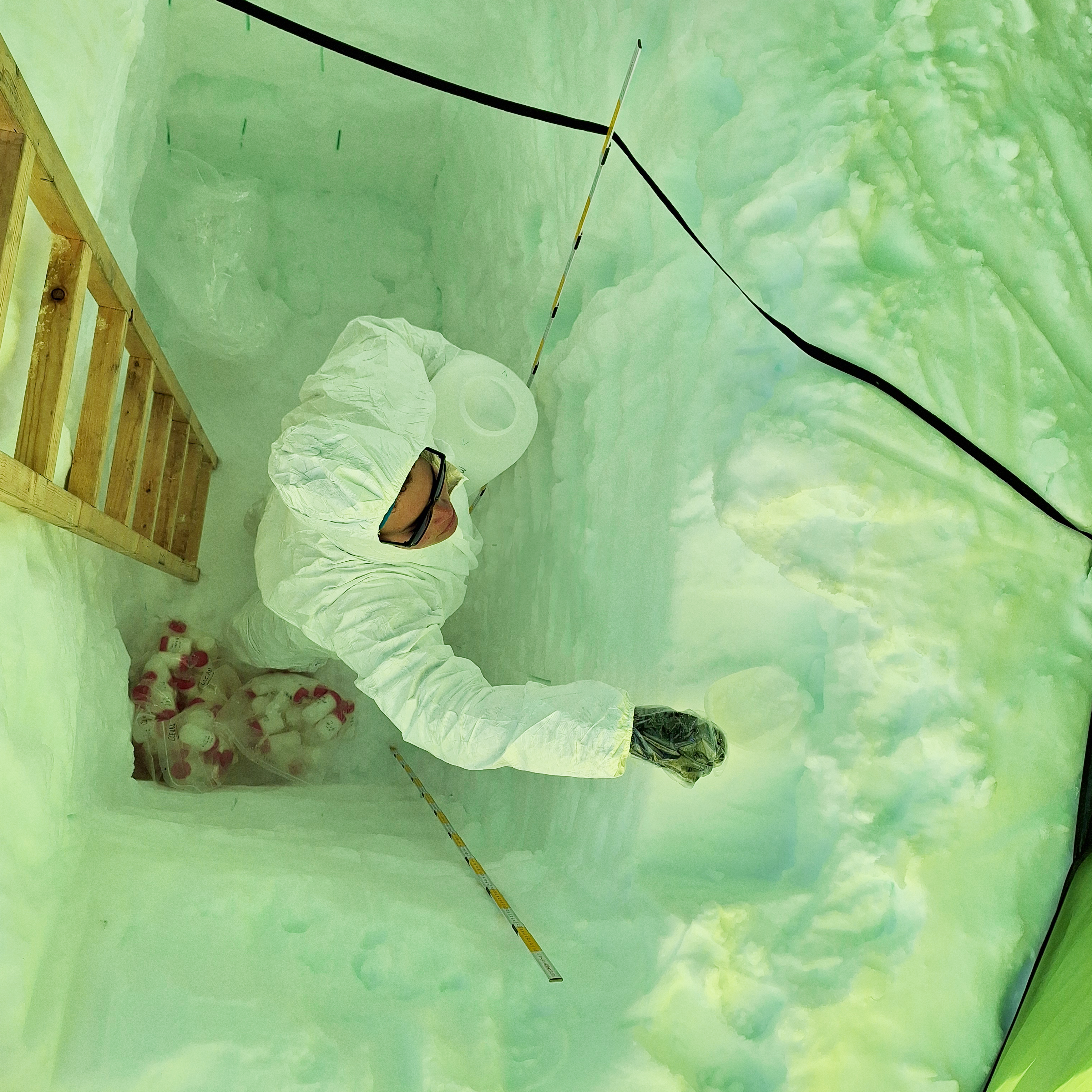
For the BELSPO-funded PASPARTOUT project, Dr. Sarah Wauthy from the Université Libre de Bruxelles (ULB) has returned safely from the coast after successfully collecting snow samples and snow cores at her first target location, the Lokkeryggen ice rise. Reaching the second planned coastal sampling point was unfortunately not possible due to extensive crevasses found on the planned route to the other sampling area. Because she couldn't access the second site, she is continuing to collect snow samples closer to the station, comparing accumulation between two different locations about 4 km from PEA, where snow deposition conditions are favorable. In addition, for the PASPARTOUT project, the team continues daily measurements for Ghent University using an active collector that captures volatile organic compounds (VOCs) from the air in the vicinity of PEA.
Rainette Engberg, working on the SnowFlux project from the EPFL, has recently installed an MRR radar system on the Utsteinen ridge. The setup which consists of a small radar dish and a sensor is designed to detect drifting snow particles. This MRR radar helps to better understand (in conjunction with other instruments installed nearby) whether snow is accumulating locally, lost by sublimation or being transported away by wind. Although the lack of wind means there is limited drifting snow at the moment, the system can still be tested and validated now. It will remain operational throughout the winter to monitor snow transport processes over time.
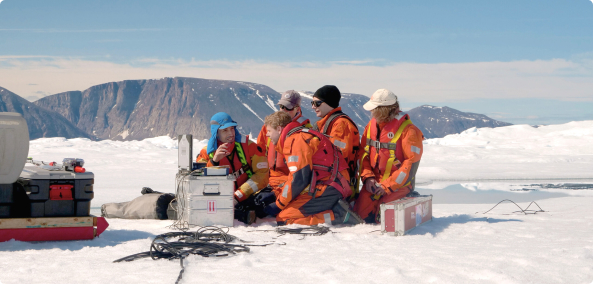
During the reconnaissance mission for PASPARTOUT, Alain and Tim were joined by Simon Steffen, who continued his work in the field servicing and maintaining the automatic weather stations (AWS) that are a part of the PEACE project. A second visit to the AWS located on the Roi Baudouin ice shelf was necessary to re-install the CNR4 net-radiometer and raise the station to ensure it survives the coming winters accumulation. The station is now once again complete and will continue collecting data autonomously throughout the Antarctic winter. At the same location the team also serviced the equipment for Dr. Eric Rignot’s NISAR project, including raising the GNSS antenna to ensure reliable data collection as conditions evolve and snow falls in the coming months. Furthermore they consolidated the set up so that everything was installed on one, opposed to two metal poles, this will make future maintenance easier.
On their way back to PEA, Alain, Tim and Simon took the opportunity to gather snow density measurements from drilling 3 meter snow cores on a regular interval along a transect from the Queen Maud Land coast to the Vesthaugen nunatak (roughly 150km transect) for the TIMBR project. This project led by the IPF is a long running project that is primarily interested in recording snow accumulation, snow density and prominent wind direction which together can provide valuable insight on this areas contribution to the surface mass balance (SMB) of the ice sheet.
Logistics and Infrastructure Updates
At the coast, Alain and Tim were also scouting for a suitable coastal location for the incoming cargo ship, expected to arrive this week. The ship will deliver essential expedition equipment and supplies and embarque all the voluminous frozen snow samples from the PASPARTOUT project. The ship will also be loaded with general waste and old materials from the station, an important effort to reduce the environmental impact and keep Antarctic operations as clean and tidy as possible.
Back at PEA, the team has made major progress on the new hangar at the Winter Park. The hangar will soon become a much-needed storage area for scientific equipment, machinery, and construction materials such as wood and metal. At the moment, most of these items are stored in containers. Once shelving and internal organization are completed, the team will finally be able to move everything into the hangar and improve logistics for the rest of the season, as well as all future expeditions.
Emergency Response and Safety Training
Finally, the team completed another safety training exercise based on two emergency scenarios occurring at the same time: one involving an injured person near the station (after a hypothetical fall from the roof) and another medical emergency occurring at the coast. While the team is familiar with both scenarios individually from previous training seasons, practicing how to manage them simultaneously is a valuable exercise in coordination and decision-making. The station doctor, David Werlen, watched carefully how the medical equipment was prepared, while also observing team dynamics to help improve and streamline future safety procedures and training methods.
Stay tuned for more updates, as the science continues, in the meantime be sure to follow along on our social media channels!
Download