


New Team Members and Scientists Arrive in Time for Christmas
On December 19th, new crew members and scientists arrived at PEA to start their mission in Antarctica. Since their arrival, they’ve been doing mandatory safety training and preparing for their field missions.
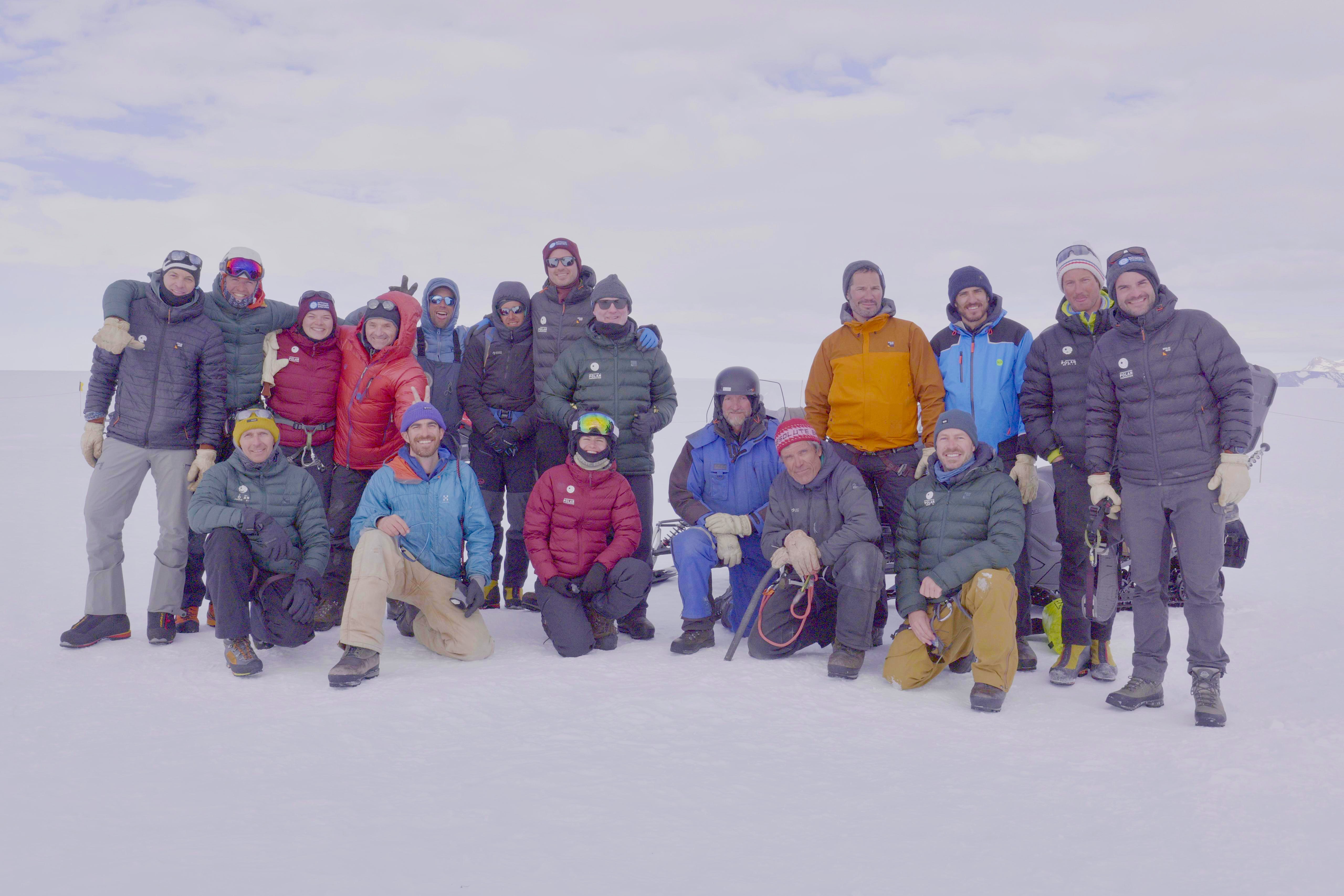
On December 19th, new crew members and scientists arrived at PEA to start their mission in Antarctica. Since their arrival, they’ve been doing mandatory safety training and preparing for their field missions.
Following ten days of work preparing the three-kilometre-long runway at Perseus International Airfield, seven new crew members and three scientists landed on December 19th to begin their mission in Antarctica. Leaving on the cargo plane the same day were eight crew members whose mission had come to a close for this season.
Once cargo and equipment had been unloaded from the plane, the new arrivals made the three-hour, 60 kilometre journey to the Princess Elisabeth Antarctica in the station’s modified Toyota Hiluxes. Upon their arrival at the station, they were first fed a hearty meal and then given a tour of the station to highlight amenities and reminded of the simple ‘house’ rules everyone is asked to abide by.
Over the last week, the newcomers have been getting used to life in Antarctica and undergoing the mandatory safety training for new arrivals: skidoo training, medical training, field rescue, GPS training with orientation exercise in the field and finally a crevasse training.
Crevasses can be the most dangerous yet beautiful physical features in Antarctica. Falling into one can be deadly, so knowing how to get a colleague out of one is vital to working safely in Antarctica. Expedition leader and experienced mountain guide Alain Hubert, assisted by another field guide, teaches team members and scientists alike how to safely scale down a crevasse with a rope and harness to retrieve someone. However, this controlled setting is a perfect opportunity to also experience the sheer beauty of this natural, physically imposing, frozen environment. Crevasses are naturally occurring stress fractures that form in the surface of a glacier, or in this case ice sheet as it attempts to navigate terrain beneath it forcing it to stretch and deform on its slow creep towards the coast.
Upcoming field expeditions at the coast
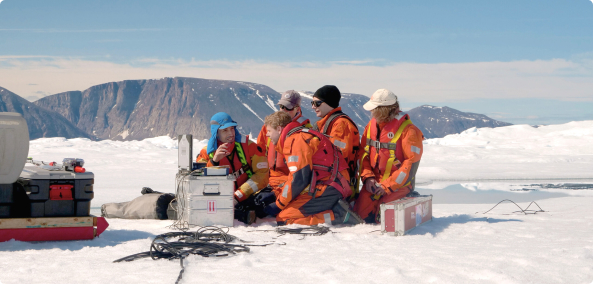
Once all the training is completed, scientists with the assistance of BELARE crew members will embark on various field campaigns to carry out the planned scientific programs.
For the BELSPO-financed PASPARTOUT project, which is studying the transport of atmospheric organic and inorganic compounds to Antarctica from the rest of the planet, Sarah Wauthy, field guide Sebastian Corret will leave at the beginning of next week for their study site near the Queen Maud Land coast, roughly 180 kilometres from PEA. Sarah plans to spend about two weeks in the field, with her time split between two different locations. She will first set up camp and dig a large snow trench on the L0 Ice Rise where she will collect snow samples to be analyzed back in Belgium. They will then travel roughly 80 kilometers west to the Hammarryggen Ice Rise and repeat the operation.
Furthermore, she will also dismantle automatic snow sampler and automatic volatile organic compound autosampler that had been set up here by her colleague two years ago. All of the snow samples collected by the autosampler over the past year as well as all the samples to be manually collected on this expedition will be shipped back to Belgium on a cargo ship in a few weeks and analysed for organic compounds and other pollutants in the glaciology laboratory at the Université Libre de Bruxelles.
At the same time, Alain Hubert and Tim Grosrenaud will carry out a reconnaissance of the area to open a new, safe route for Sarah and Sebastien to travel safely between study locations. They will then carry on to find a suitable unloading site for the container ship that will bring supplies, and material for the station which is scheduled to arrive towards the end of January.
Simon Steffen will also be joining the party to replace instruments on the automatic weather stations maintained earlier this season for the PEACE project. Simon will be dropped at the AWS installed on the King Baudouin ice shelf last season to troubleshoot the CNR4 net radiometer while Alain and Tim carry out their reconnaissance to the coast. They will also raise the high precision GNSS and AWS to ensure that they survive another year of accumulation. The following day they will travel by snowmobile roughly 40 kilometres to another site location for the NISAR project where there is a ground penetrating radar (GPR) installed on the surface to restore power to the instrument, which unfortunately failed earlier this year.
Meanwhile back at the station
There are also a few scientists getting their research projects started in the vicinity of the station, including Renette Engberg from the EPFL in Switzerland who has been hard at work collecting data from the instruments installed last year by her colleague. However, her primary objective for the season is to install new instruments for the SnowFlux project which is primarily interested in the amount of blowing and drifting snow and the effects that has on the mass balance of the ice sheet. With the support of IPF staff, she will soon replace instruments on the 30-metre tower located roughly 80 metres from the Princess Elisabeth Antarctica. She will also install a new Micro Rain Radar (MRR) on Utsteinen Ridge (where the station is anchored). MRR is an instrument operating at 24 GHz (K-band) and is a continuous wave radar that derives profiles of drop size distributions. The signal is transmitted vertically into the atmosphere where a small portion is scattered back to the antenna from rain drops or other forms of precipitation. The purpose of the project is to see what ultimately happens to precipitation in this part of Antarctica. How much stays on the ground? How much is blown away by the wind? How much is accumulated on the ground or lost by ablation?
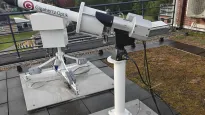
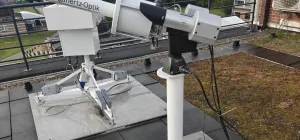
Finally for the BELSPO-financed ROMA project, a new instrument, the Pandora, will be installed alongside the Brewer Spectrometer to observe the ozone layer. The idea is to slowly phase in the new Pandora instrument to eventually replace the much older Brewer Spectrometer to ensure continued observation of the ozone layer above Antarctica, which still has not entirely healed from the massive use of anthropogenic chlorofluorocarbons throughout much of the 20th century.
A bit of Christmas Cheer
This week, the team spent a wonderful Christmas at the station, enjoying a delicious meal prepared by our long time team cook, Christine Mattel.
For everyone's joy, our colleague in Cape Town, Lisa Franco prepared several Christmas crackers (small tubes filled with little gifts that you break open). A wooden Christmas tree caringly made from leftover wood decorated the living area of the station to provide a little Christmas ambiance.
And of course in Antarctica, a White Christmas is always guaranteed!
After this nice Christmas, the team will spend the remaining days of 2025 hard at work continuing to support science. We have a lot of accomplishments to be proud of in 2025 and very much look forward to continuing our strong support into the New Year and beyond!