


Busy Week for Our Team Includes Fieldwork and Preparing Perseus International Airfield
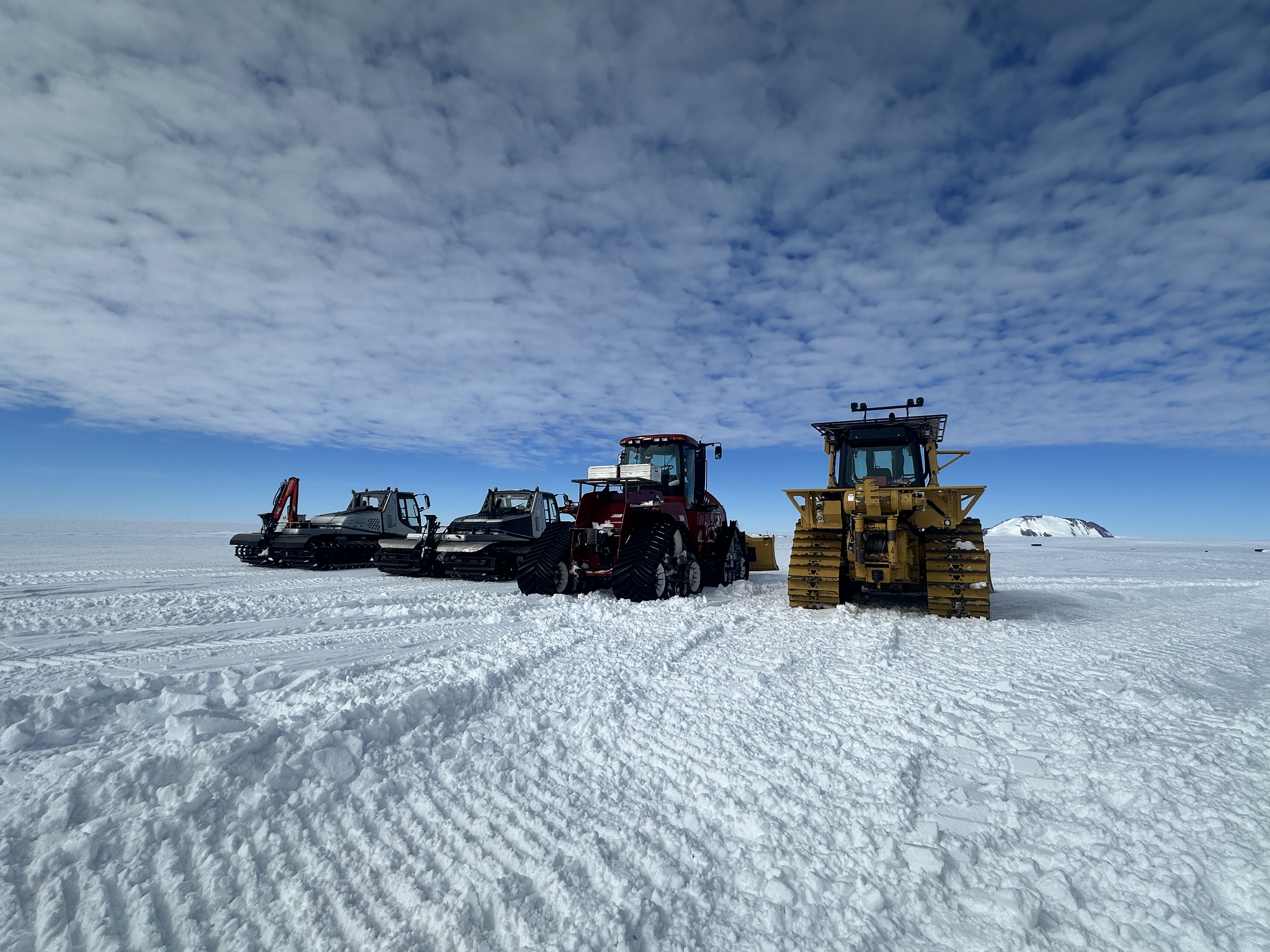
The last week the BELARE team has been busy preparing the three-kilometre long runway at Perseus International Airfield, going on field expeditions, and working on station upgrades.
The last week the BELARE team has been busy preparing the three-kilometre long runway at Perseus International Airfield, going on field expeditions, and working on station upgrades.
The BELARE team is entering an especially busy period. On December 19th, the next group of team members and three scientists will arrive from Cape Town, together with a fresh batch of supplies and more scientific equipment. The cargo plane will land at Perseus International Airfield located about 60 kilometres north of Princess Elisabeth Antarctica. For a cargo plane to land safely, the three-kilometre long runway must be clear of snow and fully groomed. This work can take between seven to ten days, depending on weather conditions and the amount of precipitation that occurred in the area over the winter, so the team is right on schedule.
In addition, the hangar at Perseus is being readied to welcome the incoming passengers. It also serves as a control tower for incoming flights. From there, team members can monitor the weather closely and inform pilots about the local conditions. When the cargo plane returns to Cape Town, some of this seasons’ BELARE team members who arrived at the start of the season will head home, just in time for Christmas!
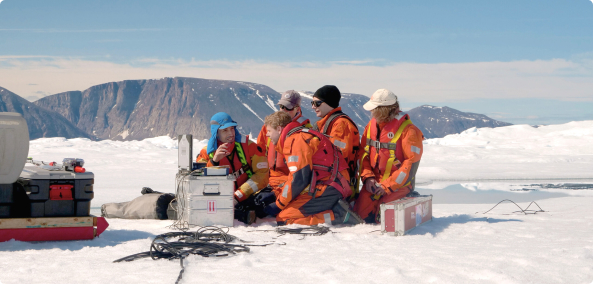
Over the previous weekend, an exciting expedition took place near the coast on the King Baudouin Ice Shelf as part of the PEACE project: Nicolas Herinckx and Simon Steffen travelled to the automatic weather stations (AWS) located on the King Baudouin Ice Shelf, which we call AWS KNG and AWS RBI. At the KNG site, they completed all necessary maintenance, replacing an HMP 45C sensor that measures temperature and humidity, as well as the sonic snow height sensor, which can acoustically measure the distance to the snow surface, allowing us to monitor if we are gaining or losing snow/ice. Furthermore, the pressure sensor also needed to be replaced. Last but not least the CNR4 (net radiometer) needed a bit of tweaking. However, after a few hours on-site all channels were once again running smoothly and AWS is set to autonomously collect data for the next year.
The following morning the guys visited the other AWS site location, which is 40 km further out on the ice shelf from the KNG AWS located at the grounding line (where the ice sheet begins to extend and float over the southern ocean). Even though all instruments were working, our team decided to remove the CNR4 net radiometer to thoroughly troubleshoot it back at PEA, since the readings didn’t appear to be 100% accurate. IPF wants to ensure that all stations are recording parameters correctly, so they made the tough decision to remove the instrument, which will be inspected and returned to the site in the coming weeks to continue its job, monitoring short and long-wave radiation.
The guys also checked on two ground penetrating radar units for the NISAR project led by Eric Rignot from the University of California Irvine, which have been operational for the past one and two years respectively. These instruments are installed in wooden box ‘coffins’ on the surface of the ice sheet and are continuously taking radar measurements down through the ice shelf, measuring ice thickness and monitoring any potential melt occurring from the bottom up, where the ocean comes in contact with the underside of the ice shelf. The data was retrieved from these two sites and shared with Dr. Rignot and his team for analysis. Unfortunately, one system that had been installed in 2024 lost power over the winter months and the 12V battery powering the system was completely drained. Our team will return with a new 12V battery in a couple weeks to bring this unit back online.
The return journey to PEA took nearly 12 hours, as Nicolas and Simon had to traverse very rough terrain. One snowmobile experienced technical issues when they were still 130 km from the station. An improvised solution helped the snowmobile make it another 65 km, but after a point they had to abandon the broken snowmobile and both head back to the station together on the same snowmobile. A few colleagues from the BELARE team returned the next day with another vehicle to bring back the broken vehicle for repairs. It was a demanding end to the mission, but experiences like this can happen when working in such harsh and remote environments.
Once back at PEA, the guys continued to work on the PEACE project, servicing AWS Blue, which is close to Perseus International Airfield. This is the AWS responsible for providing all the meteorological data to pilots. There was just one sensor (again an HMP 45C) that needed to be replaced. Some of the code running the program was re-worked on-site. Thankfully there were perfect conditions in a typically high wind area.
On their way back, they also installed a new, basic AWS on Vesthaugen Nunatak (30 km north of PEA and 30 km south of Perseus). Setting up this new AWS brought with it a unique set of challenges, as it was installed on rocks instead of ice, and was roughly eight metres (25 feet) tall. Such a tall mast can be difficult to raise, and is extremely unstable until it can be properly anchored with steel guide wires that are drilled into the surrounding rocks. They only installed a basic AWS as we are primarily interested in the available wind energy at this location, so the guys fitted it with two anemometers located near the very top of the mast as well as one temperature and humidity sensor (HMP 45C) and one thermocouple.
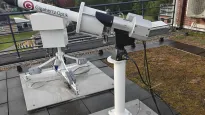
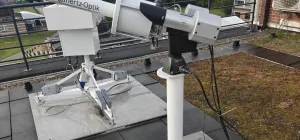
Back at PEA, the week continued as other members of our team continued working on instruments of scientific projects that had been installed a few seasons ago to run autonomously. These include the Brewer ozone spectrophotometer, which needed recalibration before continuing to collect data for the PASPARTOUT project.
Work also continued on the ACME project, which launches weather balloons equipped with radiosondes three times per week. The team now uses a new series of new radiosondes that create a smaller environmental footprint and collect a more accurate data profile during its rise through the atmosphere. They also use a new software interface purchased prior to the season and installed at the station’s north scientific shelter, where the dedicated computer for the ACME project is housed.
Follow us here and on our social media channels to stay updated on the progress at the Perseus International Airfield and all the other exciting work at the world’s only zero-emission station in Antarctica!
Download